
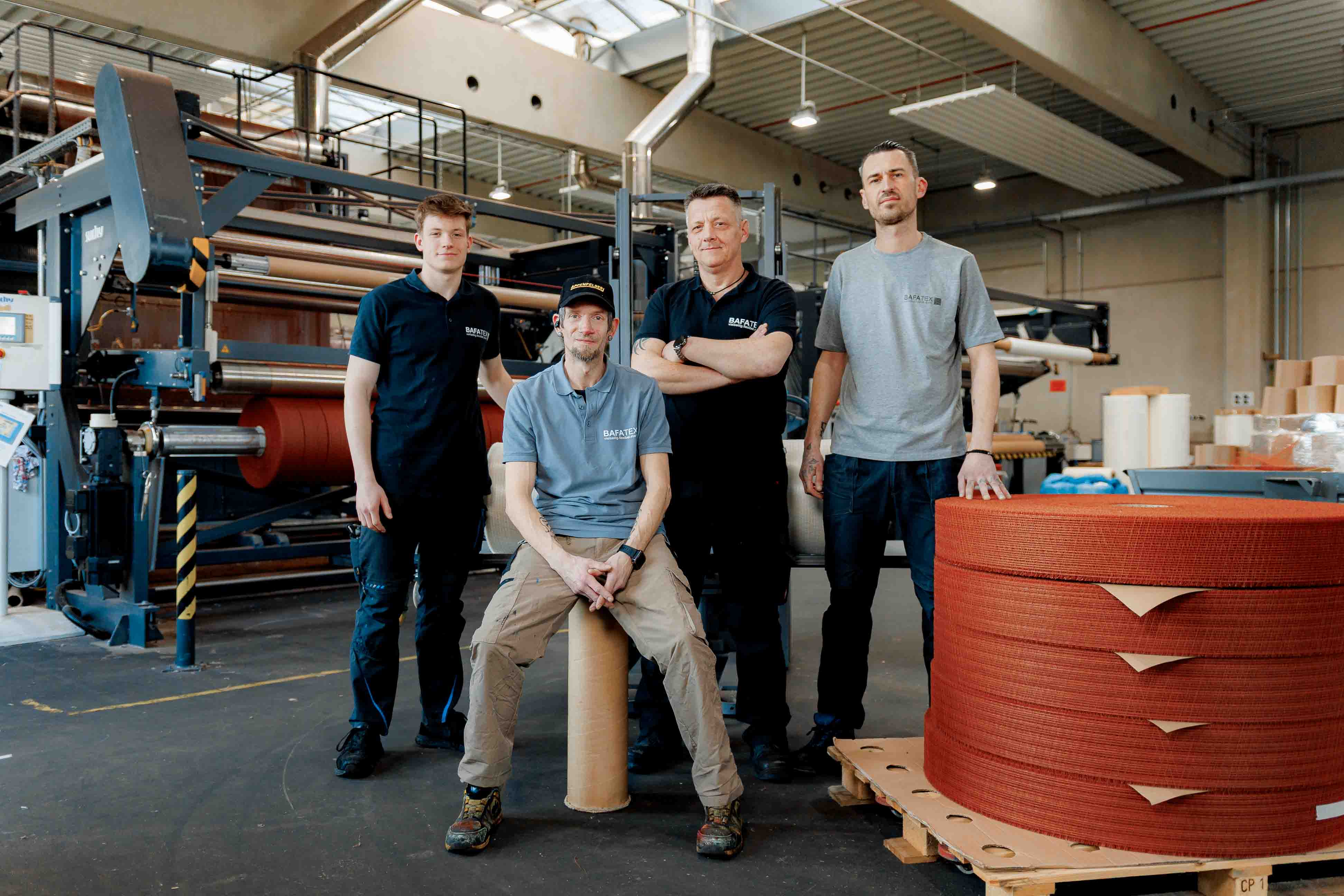
We supply packaging manufacturers with environmentally sustainable laid scrims made from renewable raw materials. They significantly increase the tear strength of packaging and can also be integrated into retail packaging as breathable, visually appealing viewing windows.
This added value helps to win new customers, avoid plastic waste and meet packaging regulations more easily.
Avoiding packaging waste is becoming a question of cost and revenue for industry and retail, as the global waste crisis leads to ever stricter legislation. Germany’s Packaging Act (VerpackG), in force since 2019, tightened the previous Packaging Ordinance and is only an intermediate step towards stricter requirements and bans.
Section 15 VerpackG obliges packaging manufacturers to take back empty packaging or join a collection scheme – which becomes cheaper if products are easier to recycle or biodegradable.
Section 21(2) No. 2 requires incentives for the use of renewable raw materials.
Annex 1 VerpackG shows how broadly “packaging” is defined, from retail flower pots to cores for fabrics or films.
The biggest challenge for packaging manufacturers is Section 16 VerpackG:
In future, packaging will have to be either almost entirely recyclable or biodegradable. Manufacturers whose products do not meet these criteria will struggle to remain in the market.
The public and policymakers are no longer willing to accept “thermal recycling” (incineration, cement production) as recycling of plastic waste. The actual recycling rate, according to the Wuppertal Institute for Climate, Environment and Energy, is only 5.6 %, and this mixed recyclate is mostly turned into granulate for simple plastic products such as buckets and park benches. Plastics made from plant starch are unlikely to offer a real alternative:
Legislation is therefore expected to move in the following directions (in descending order of priority):
We support this with laid scrims made from renewable, biodegradable raw materials:

In composite packaging, laid scrims outperform woven fabrics: high tear strength and transparency with a minimal share of volume.
The image below shows composite packaging made of paper and a viscose laid scrim. Even when fully bonded to the inside, the laid scrim’s share of the packaging mass is so low that the packaging can be disposed of with paper and board recycling.
Thanks to their multiaxial structure and bonding, laid scrims are lighter, more open and more breathable than conventional woven fabrics, while increasing the tear strength of paper packaging – especially around punched holes.
Our natural fibre laid scrims are also available with a bio-based adhesive.
BAFA® laid scrims give retail and transport packaging the properties customers expect:
The properties of BAFATEX® laid scrims can be tailored through several variables:
In packaging, laid scrims are particularly suitable for transport, retail and outer packaging that needs reinforcing against tearing.
Paper and board packaging in contact with food is governed by Regulation (EC) No 1935/2004, Regulation (EC) No 2023/2006 and – where recycled paper is used – Recommendation XXXVI of the German Federal Institute for Risk Assessment (BfR).
BAFATEX® laid scrims extend product capabilities and add a visibly premium quality. Components made from renewable raw materials make it easier to meet statutory recycling and biodegradability targets.
To ensure consistently high product quality, BAFATEX has been ISO 9001 certified since 1994. Drawing on decades of experience, we are happy to advise on the properties and processing options of our laid scrims.
For product managers:
For engineers and production managers:
Leiersmühle 19
51688 Wipperfürth/Germany
E-mail: info@bafatex.de
Phone: +49 (0) 22 67 87 13-0