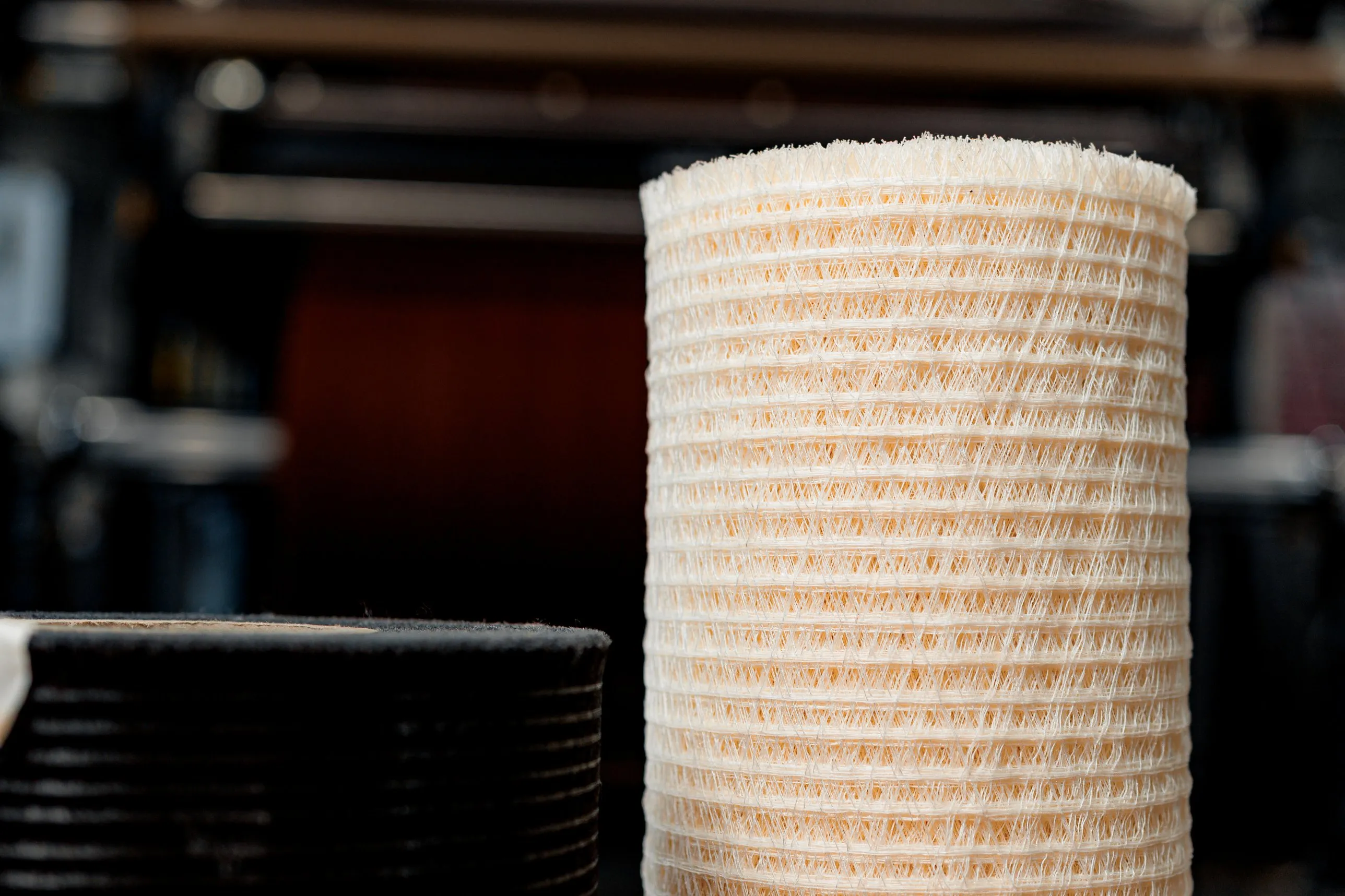
A laid scrim (German: Fadengelege) is an open textile fabric in which sets of yarns are laid straight on top of each other and bonded at the crossing points with a binder, without being woven or knitted. Laid scrims serve as a light reinforcing layer in films, papers, nonwovens, foams and adhesive tapes.
To the product advisor →A laid scrim consists of three components: longitudinal yarns (warp) running in the machine direction, weft yarns laid across them crosswise or diagonally, and a binder that bonds the yarns at every crossing point.
Because the yarns lie straight and do not interlace, the scrim is flat, light and open. Coatings, adhesives or films bond through the open grid.
Typical values at BAFATEX: 20 to 1,000 longitudinal yarns per 100 cm, diagonal weft spacing 5 to 50 mm, widths from 100 to 2,700 mm.
In a woven fabric the yarns interlace, in a nonwoven the fibres lie randomly and are consolidated, and in a non-crimp fabric (NCF) heavy fibre layers are stitched together. Of these four fabrics, the laid scrim is the lightest and most open.
Conventional rectangular scrims have yarns in only two directions, lengthwise and crosswise (0° and 90°). If a force pulls at an angle, for example during cutting, at a nail hole or during winding, the grid distorts into a parallelogram and a tear can run on between the yarns.
Diagonal and triaxial laid scrims from BAFATEX place the yarns in 6, 8 or 10 directions. As a result, they also absorb forces at an angle to the web, remain dimensionally stable and stop tear propagation earlier. For the reinforced web, this means more strength from all directions at a comparable areal weight.
Laid scrims are made from filament yarns. Standard yarns at BAFATEX are polyester, glass and viscose filament.
On request, polyamide, carbon, aramid (Kevlar®, Technora®, Twaron®), Nomex® and natural fibres such as cotton, flax, jute, hemp and sisal are used. With steel fibre yarn, the scrim becomes electrostatically dissipative.
On the scrim line, the longitudinal yarns run off bobbins as the warp. The weft yarns are laid across them crosswise or diagonally, in 6, 8 or 10 directions with the BAFA® process.
A binder then bonds the yarns at the crossing points; the scrim is dried and wound up. BAFATEX invented the BAFA® laid scrim process and has been producing laid scrims in Wipperfürth since 1959.
Laid scrims are used in six industries. Each industry has its own page with all applications, technical data and frequently asked questions.
No. In a woven fabric the yarns interlace; in a laid scrim they lie straight on top of each other and are bonded at the crossing points. This makes the scrim flatter and lighter than a woven fabric of the same strength.
Triaxial means that the yarns lie in three axes: lengthwise and in two diagonal directions. This allows the scrim to absorb forces at an angle to the web as well.
Fadengelege. In technical texts, the short form Gelege is also common.
Rectangular scrims only have yarns lengthwise and crosswise (0° and 90°). Diagonal and triaxial laid scrims place the yarns in 6, 8 or 10 directions, also absorb forces at an angle and stop tear propagation earlier.
Ultralight polyester scrims start at approx. 3 g/m². The areal weight depends on yarn, yarn spacing and binder.
As a light reinforcing layer in paper and packaging, adhesive tapes, tarpaulins and films, composites, nonwovens, building and flooring products, and protection systems.
The fastest way to a suitable quotation from BAFATEX is to configure your scrim in the product advisor and send the enquiry from there. Phone +49 2267 87130, e-mail info@bafatex.de. BAFATEX is ISO 9001 certified.
To the product advisor →