Technical data
| Yarns | Viscose (heat-sealable), PES filament (e.g. 500 dtex), natural fibres such as flax, hemp and cotton |
| Proven types | MVG 100/20 (mosaic parquet) |
| Widths | Panel widths e.g. 480 / 540 / 635 mm; up to 2,700 mm |
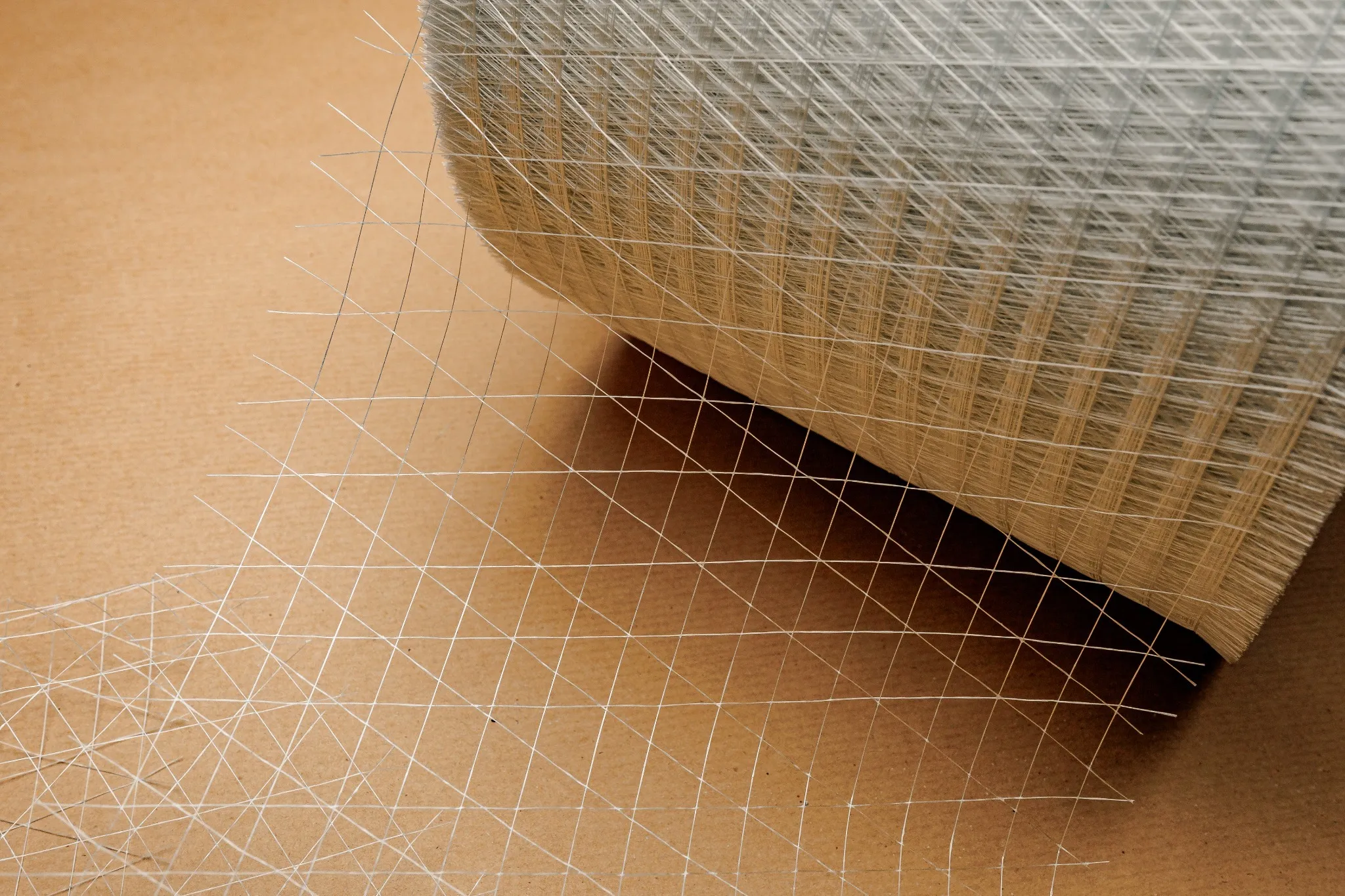
| Construction | Diagonal and triaxial laid scrims in 6, 8 or 10 directions; also absorb forces at an angle, unlike conventional rectangular scrims |
| Diagonal weft spacing | 5 to 50 mm |
| Longitudinal yarns | 20 to 1,000 per 100 cm |
| Binder | PVAC or SB based; flame-retardant and food-compliant on request |
| Colours | Natural or individually dyed |
| Rolls & cores | Roll length and core to suit the line; large rolls up to 10,000 m |
| Order quantity | Samples without minimum quantity, series production from 10,000 m² per year |
| Lead time | Samples at short notice, series typically 4 to 8 weeks |
| Capacity | approx. 50 million m² per year, 10 production lines |
| Quality | ISO 9001, certified by Bureau Veritas |
| Origin | Wipperfürth, Germany; laid scrims since 1959; exports to more than 20 countries |
Laid scrims for roofing, facades and waterproofing
Roofing, facade and waterproofing membranes must withstand tensile forces and temperature changes during installation and in use. A laid scrim reinforces them without making them noticeably heavier or thicker.
Roofing underlays and breather membranes
Diagonal yarns increase tear propagation resistance at nail and staple points.
Facade and wall membranes
The open grid bonds film and nonwoven in multi-layer facade membranes.
Vapour retarders and vapour barriers
Scrim-reinforced vapour retarders remain dimensionally stable during installation and do not tear further.
Bitumen and synthetic roofing membranes
In bitumen and synthetic membranes, the scrim serves as a light reinforcing layer.
Facts and benefits
- Lighter and flatter than a woven fabric
- Open grid bonds film and nonwoven
- Diagonal yarns stop tear propagation
Laid scrims for insulation and interior finishing
In insulation materials and wall coverings, the scrim reinforces facings and surfaces. For ecological building materials, BAFATEX also produces scrims from natural fibres.
Insulation materials and aluminium facings
The scrim reinforces aluminium foils on mineral wool and other insulation materials.
Acoustic and sound insulation elements in buildings
In sound insulation elements, the scrim holds nonwoven and insulation layers together. Acoustic parts in vehicles are covered under Composites & Lightweight.
Wallpapers and wall coverings
A scrim makes wallpapers and wall coverings more tear-resistant during application.
Room dividers and decorative elements
Dyed scrims are made into room dividers and decorative elements.
Facts and benefits
- Natural fibre scrims for ecological building materials
- Reinforcement of aluminium foils on insulation materials
Laid scrims for floor coverings
In floor coverings, a heat-sealable scrim keeps individual elements such as parquet strips or mosaic tiles in position and shape until they are laid.
Solid wood mosaic parquet panels
The heat-sealable scrim is applied to the back of the wooden strips with heat and pressure. The proven type is MVG 100/20.
Stone and glass mosaic on mesh
Mosaic tiles are glued onto a scrim net and laid as a tile.
Carpet tiles for office floors
The scrim keeps carpet tiles dimensionally stable so that they lie flat.
Carpet backing, tufted and woven
In tufted and woven carpets, the scrim reinforces the backing.
Outdoor and synthetic running tracks
Sports and outdoor surfaces such as synthetic running tracks are also reinforced with scrims.
Facts and benefits
- Heat-sealable scrim: the adhesive reactivates with heat and pressure
- Yarns viscose (heat-sealable), PES filament (e.g. 500 dtex), natural fibres
- Proven type MVG 100/20 for mosaic parquet
- Panel widths e.g. 480 / 540 / 635 mm
Why diagonal and triaxial laid scrims
Forces from every direction
Diagonal and triaxial laid scrims place their yarns in 6, 8 or 10 directions. They also absorb forces at an angle to the web, not only lengthwise and crosswise like conventional rectangular scrims.
Tear propagation stopped
The diagonal yarns stop a tear earlier, for example at nail holes, punched edges or during winding.
Dimensionally stable when cut
The grid does not distort into a parallelogram during cutting, winding and laminating.
What is a laid scrim? Definition and comparison →
References
Parquet manufacturers in Germany, Poland and Slovakia
Mosaic parquet producers in Portugal, Spain and Croatia
Manufacturer of carpet backing in the Netherlands
Frequently asked questions about laid scrims for building and flooring
Why diagonal laid scrims for roofing and facade membranes?
Diagonal and triaxial scrims absorb forces not only lengthwise and crosswise but also at an angle to the web. This increases tear propagation resistance, for example at nail and staple points, and keeps the membrane dimensionally stable during installation.
How does a laid scrim hold mosaic parquet together?
A heat-sealable scrim is applied to the back of the wooden strips with heat and pressure. The adhesive reactivates, and the scrim keeps the elements in position and shape until the panel is laid in the adhesive bed.
Are there laid scrims made of natural fibres for ecological building materials?
Yes. BAFATEX also produces scrims from natural fibres such as flax, hemp and cotton.
Which widths are possible for floor panels?
Typical panel widths are 480, 540 or 635 mm. Overall, BAFATEX produces infinitely variable widths up to 2,700 mm.
Is BAFATEX certified?
Yes, BAFATEX is ISO 9001 certified, audited by Bureau Veritas.
Further applications
Request a laid scrim for your product
The fastest way to a suitable quotation from BAFATEX is to configure your scrim in the product advisor and send the enquiry from there. Phone +49 2267 87130, e-mail info@bafatex.de. BAFATEX is ISO 9001 certified.
To the product advisor →